Fake Cement and Rising Material Costs: What Ghana’s Construction Quality Crisis Means for Property Buyers
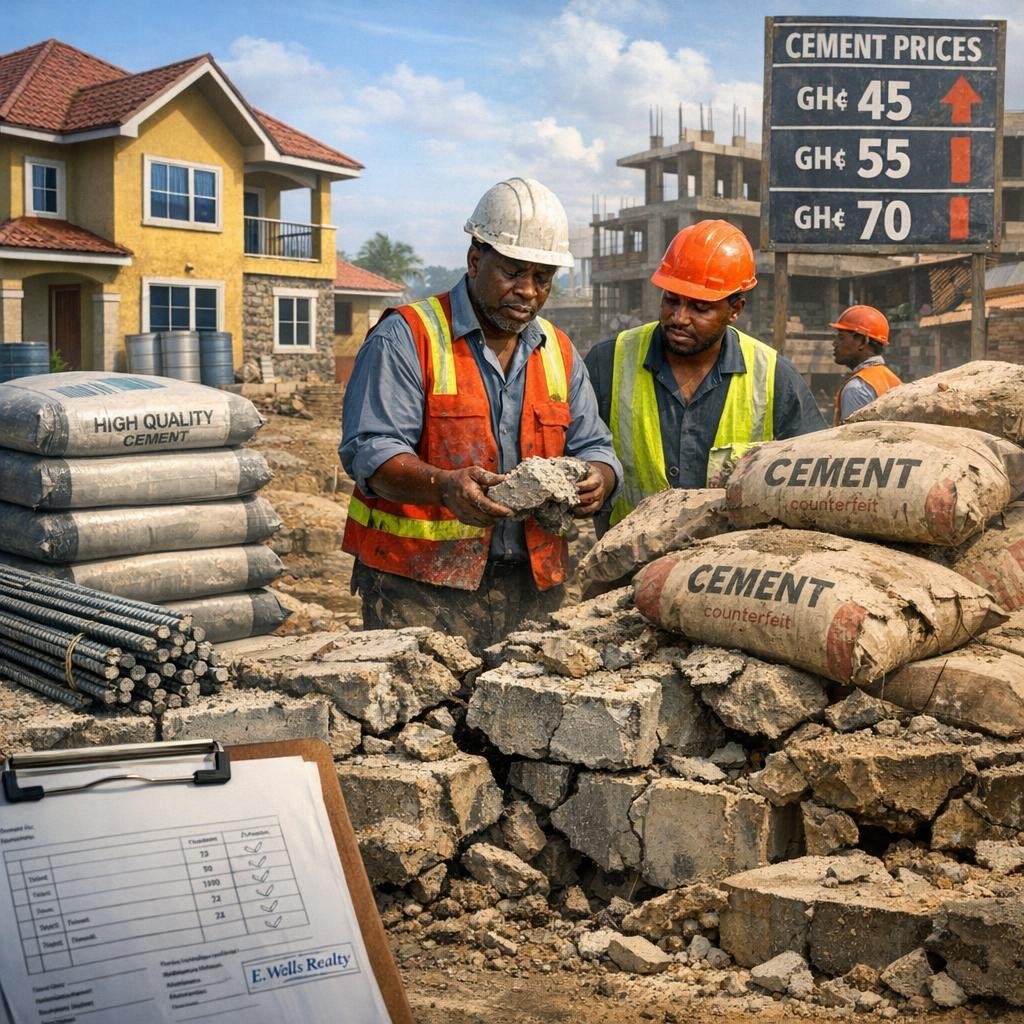
Ghana’s construction industry is confronting a dual challenge that every property buyer and investor needs to understand. A global clinker shortage has opened the door for counterfeit cement to flood the market, while the cost of legitimate building materials has surged by as much as 40% over the past two years. According to Listings Pro GH, fake cement products containing little to no clinker, the essential binding ingredient in cement, are being sold at prices equal to or higher than genuine products, exploiting buyers during the shortage. At the same time, GhanaWeb reports that the Engineering Council of Ghana has observed contractors increasingly turning to cheaper, inferior materials to offset costs, with cement prices reaching GHS 96 per bag by late 2022 and iron rods climbing from GHS 5,400 to as much as GHS 8,000 per tonne.
This is not an abstract industry problem. Buildings constructed with fake cement develop serious structural defects within months, concrete blocks crumble prematurely, and foundations fail long before they should. Ghana recorded at least five building collapses under construction in recent months, some with loss of life. For anyone buying property, commissioning a build, or investing from abroad, the integrity of construction materials is now a front-line due diligence issue.
Core insight: The combination of material cost inflation and counterfeit products in circulation means that verifying not just land title, but also construction quality and material sourcing, has become essential to protecting your investment in Ghana’s property market. Buyers can no longer assume that a completed or ongoing project meets safety standards without independent verification.
What Is Driving the Counterfeit Cement Problem?
Clinker is the active ingredient that gives cement its binding strength and structural integrity. A worldwide shortage has created scarcity in Ghana, and unscrupulous suppliers have filled the gap with counterfeit products made from sand, ash, limestone dust, or chalk. These fakes are not always cheaper, many are priced at or above market rate, targeting buyers who assume price reflects quality.
Genuine cement begins hardening within 30 to 60 minutes when mixed with water and generates noticeable heat during the curing process. Fake cement remains soft, does not warm up, and may separate or stay powdery when dry. The Ghana Standards Authority has been working to address the issue, but the onus remains on buyers and developers to source materials only from established, reputable suppliers with verifiable business histories and permanent locations.
How Are Rising Material Costs Affecting Construction Quality?
The Registrar of the Engineering Council of Ghana, Wise Ametefe, confirmed to GhanaWeb that contractors are using cheaper, inferior materials to manage the high cost of construction. Cement prices increased by approximately 40% between early 2022 and the end of that year, driven by Cedi depreciation, high import duties, and elevated production costs for local manufacturers. Iron rods saw similar increases.
While the Council cannot definitively link inferior materials to recent building collapses, the trend is clear: cost pressure is compromising material selection. Ametefe emphasized that safety must never be sacrificed for cost, stating, “Whether expensive or not, we encourage builders to go for the best quality.” For buyers, this means that even projects managed by licensed contractors may be at risk if material sourcing is not independently verified.
What Do the Ghana Standards Authority’s New Cement Guidelines Mean for Buyers?
In response to these challenges, the Ghana Standards Authority has issued specific guidelines on cement types and their appropriate uses, as reported by Citi Newsroom. The guidelines, part of the Ghana Standards Authority (Manufacture of Cement) Regulations, 2023 (L.I. 2480), categorize cement by grade and application.
Portland Limestone Cement (32.5R) and Portland Composite Cement (32.5R) are recommended for general construction tasks including plastering, masonry, and screeding. Portland Limestone Cement (42.5R) is suitable for concrete products like building blocks and pavement slabs. Portland Limestone Cement (42.5N) is designed for ready-mixed concrete and high-rise construction. Portland Limestone Cement (52.5N) is ideal for structural elements in high-rise buildings, including beams, columns, and suspended slabs. Masonry Cement (MC 12.5/22.5) is formulated specifically for plastering, block laying, tiling, and screeding.
These guidelines provide a clear standard for what should be used where. Buyers and their representatives should verify that the correct grade of cement is being used for each stage of construction, and that all materials are sourced from suppliers who comply with GSA standards.
What Does This Mean for Diaspora Investors and Local Buyers?
This story speaks directly to diaspora investors and anyone commissioning a build from a distance. If you are not on the ground to inspect materials as they arrive on site, you are exposed to significant risk. Fake cement and substandard materials are not always visible until structural problems emerge, often months or years after construction is complete.
For diaspora clients, this reinforces the need for trusted, on-ground representation throughout the construction process. It is not enough to hire a contractor and check in periodically. Material sourcing, delivery verification, and adherence to GSA guidelines must be monitored at every stage. Non-citizens acquire property in Ghana through renewable leaseholds of up to 50 years, and protecting that investment means ensuring the structure itself is sound, not just the title.
Local buyers face the same risks, but may have more opportunity to visit sites and ask questions directly. Even so, the technical knowledge required to distinguish genuine cement from counterfeit, or to verify that the correct grade is being used for a given application, is beyond most buyers. This is where independent consultancy support becomes essential.
Is Now a Good Time to Buy or Build in Ghana?
The market has not stopped. Demand for housing in Accra and other urban centers remains strong, and property continues to be a preferred asset class for both local and diaspora investors. However, the current environment requires a higher level of diligence than in previous years.
Buying a completed property from a reputable developer with a track record may carry less risk than commissioning a new build, but even completed properties should be inspected for structural integrity, particularly if construction took place during the period of material cost inflation and clinker shortage. For those building, working with a consultancy that can verify material sourcing, monitor construction progress, and ensure compliance with GSA standards is no longer optional, it is a core part of protecting your investment.
What Should Buyers and Investors Do Next?
First, if you are buying a completed property, commission an independent structural inspection before finalizing the transaction. If you are building, ensure that your contractor sources materials only from established suppliers, and that every delivery is verified against GSA standards. Request documentation for all cement purchases, including grade and supplier details, and confirm that the correct type is being used for each stage of construction.
Second, recognize that land title verification, while essential, is only one part of due diligence in Ghana’s property market. Construction quality and material integrity are equally important, and both require on-ground expertise. Land registration in Ghana typically takes 6 to 12 months, and land-related disputes are common, which is why title verification before payment is non-negotiable. But a clean title on a structurally unsound building is not a safe investment.
Third, if you are investing from abroad, work with a consultancy that can act as your eyes and ears throughout the process. E. Wells Realty & Consultancy provides vetted listings, consultancy support, and on-ground guidance through every stage of a transaction, whether the client is local or abroad. In an environment where material fraud and cost-cutting are real risks, having a trusted partner who understands both the market and the technical standards is essential.
Frequently Asked Questions
How can I tell if cement is fake before using it in construction?
Genuine cement begins hardening within 30 to 60 minutes when mixed with water and generates noticeable heat during curing. Fake cement remains soft, does not warm up, and may separate or stay powdery when dry. Always source cement from established, reputable suppliers with verifiable business histories and permanent locations, and request documentation confirming compliance with Ghana Standards Authority specifications.
What type of cement should be used for a residential house foundation in Ghana?
According to the Ghana Standards Authority guidelines, Portland Limestone Cement (42.5N) is designed for ready-mixed concrete production and high-rise building construction, making it suitable for residential foundations. For structural elements like beams and columns in multi-story homes, Portland Limestone Cement (52.5N) is recommended. Always verify that your contractor is using the correct grade for each stage of construction.
Should diaspora investors delay building projects until material costs stabilize?
Material cost fluctuations are part of any construction market, and waiting indefinitely may mean missing other opportunities. The key is not timing the market, but ensuring rigorous oversight of material sourcing and construction quality. Working with a trusted consultancy that can verify materials, monitor progress, and enforce compliance with safety standards allows you to proceed with confidence, regardless of broader cost trends.
E. Wells Realty & Consultancy has been a trusted name in Ghana’s property market since 2014, guiding clients through every stage of buying, selling, and building with the care of a trusted advisor. Explore current listings, learn more about our consultancy services, or reach out directly at info@ewellsconsult.com to discuss how we can support your next step in Ghana’s real estate market.