
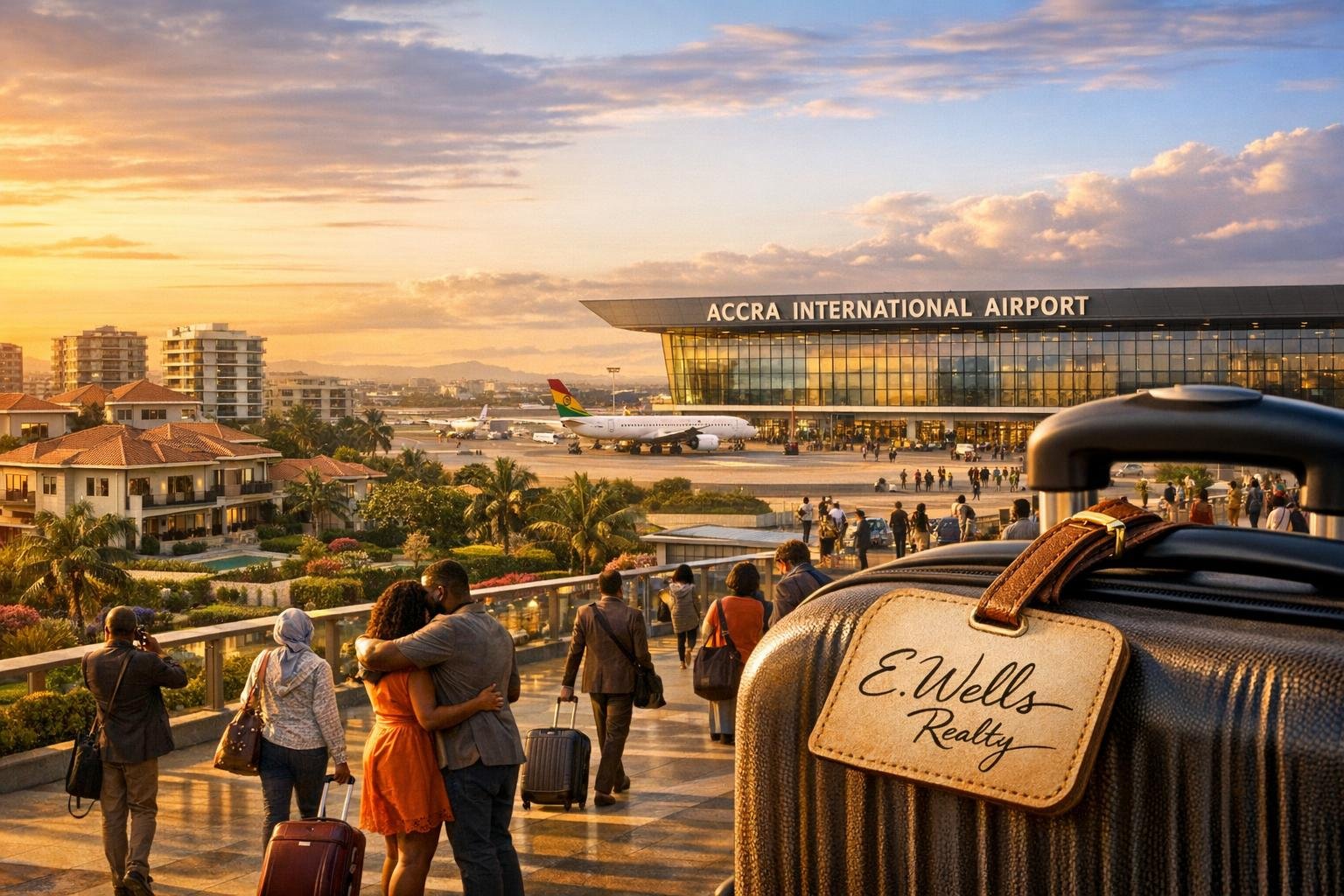
Accra International Airport: What Ghana’s Gateway Renaming Means for Property Investors
The Government of Ghana has officially renamed the country’s main international airport, reverting from Kotoka International Airport back to its original designation, Accra International Airport. The Ministry of Transport announced the change in a press statement on Monday, February 23, 2026, according to GhanaWeb and multiple national outlets. The decision reverses a 1969 policy that had honored Lieutenant General Emmanuel Kwasi Kotoka, restoring the facility to the name it held before that year.
The announcement was confirmed by Majority Leader Mahama Ayariga during a leadership session and has generated considerable discussion across Ghana and among the diaspora community. As the nation’s primary international gateway, the airport’s identity carries symbolic weight that extends beyond aviation policy.
Core insight: While the renaming itself is administrative, it signals the current government’s willingness to revisit legacy decisions and may reflect a broader effort to modernize Ghana’s international brand. For property investors, the airport’s role as the first and last touchpoint for international arrivals remains unchanged, and the surrounding neighborhoods continue to benefit from proximity to this critical infrastructure.
What Does This Mean for Ghana’s International Profile?
The name Accra International Airport positions the facility with a city-first identity, similar to major global hubs like Dubai International Airport or Singapore Changi Airport. This approach emphasizes place over historical figure, which may support efforts to market Accra as a regional business and investment destination.
The airport serves as Ghana’s primary point of entry for international travelers, including the thousands of diaspora Ghanaians who return each year to visit family, explore investment opportunities, or retire. Any policy shift that affects the airport’s identity or operations naturally draws attention from this community, even when the change is largely symbolic.
Who Should Pay Attention to This News?
This story speaks most directly to diaspora investors and returnees. The airport is not just infrastructure; it is the physical threshold between life abroad and life in Ghana. Its name, its efficiency, and its reputation shape the first impression of every trip home.
For diaspora clients considering property investment in Ghana, the renaming itself does not alter market fundamentals. However, it serves as a reminder that government policy can shift, and that long-term investment decisions should be grounded in verifiable assets, not assumptions about political continuity.
What Does This Mean for Property Near the Airport?
Neighborhoods within a 10 to 20 minute drive of the airport, including Airport Residential Area, Cantonments, and parts of East Legon, have long commanded premium pricing due to their proximity to the international gateway. These areas are popular with expatriates, returning diaspora professionals, and business travelers who value convenience and connectivity.
The renaming does not change the airport’s location or function, so property values in these neighborhoods are unlikely to be directly affected. What matters more to buyers and investors is the airport’s operational capacity, flight connectivity, and the quality of surrounding infrastructure, all of which remain constant.
That said, any government attention to the airport, whether through renaming, expansion plans, or service improvements, can indirectly benefit nearby real estate by reinforcing the area’s status as a high-access, internationally connected zone.
Is Now a Good Time for Diaspora Clients to Invest in Accra?
The timing of an investment should be driven by personal readiness, verified opportunity, and clear financial planning, not by symbolic policy changes. However, diaspora investors who have been considering property in Accra should focus on the fundamentals that make any purchase sound.
Non-citizens acquire property in Ghana through renewable leaseholds of up to 50 years; freehold is generally reserved for citizens. This legal structure is well-established and unaffected by the airport renaming. What remains critical is title verification before payment, as land-related disputes are common in Ghana’s courts. Land registration typically takes 6 to 12 months, and working with a consultancy that conducts Lands Commission searches and verifies ownership is non-negotiable.
For diaspora buyers, proximity to the airport is often a practical priority, especially for those who split time between Ghana and abroad or who plan to rent to expatriate tenants. Properties in airport-adjacent neighborhoods tend to attract stable rental demand, though buyers should verify title, assess neighborhood infrastructure, and understand leasehold terms before committing.
What Should Diaspora Investors Consider Next?
If you are a diaspora investor evaluating property in Accra, the airport renaming is a useful moment to refocus on what actually protects your investment: verified title, transparent transaction processes, and on-ground support you can trust.
Start by identifying neighborhoods that match your goals, whether that is rental income, a retirement home, or a family base. Airport Residential Area, Cantonments, East Legon, and Labone are established zones with strong infrastructure and international appeal. Newer developments in Oyarifa, Adjiringanor, and Tsopoli offer more space at lower entry prices, though they require careful vetting.
Work with a consultancy that conducts full due diligence, including Lands Commission searches, site inspections, and seller verification. E. Wells Realty & Consultancy provides vetted listings, consultancy support, and on-ground guidance through every stage of a transaction, whether the client is local or abroad. This is especially important for diaspora buyers who cannot be physically present for every step of the process.
Understand your financing options. Some diaspora investors pay cash to avoid currency risk and interest costs. Others explore mortgage products offered by Ghanaian banks to diaspora clients, though these typically require proof of income, a down payment of 20 to 30 percent, and may carry higher interest rates than local mortgages.
Finally, plan for the long term. Property investment in Ghana is not a quick flip. It is a multi-year commitment that benefits from patience, local knowledge, and a clear understanding of leasehold renewal processes, property taxes, and maintenance responsibilities.
Frequently Asked Questions
Does the airport renaming affect property values near the airport?
The renaming itself is unlikely to have a direct impact on property values. What drives pricing in airport-adjacent neighborhoods is proximity, infrastructure quality, security, and rental demand, all of which remain unchanged. The airport’s function as Ghana’s primary international gateway continues regardless of its name.
Can diaspora investors buy property near the airport in Accra?
Yes. Non-citizens can acquire property in Ghana through renewable leaseholds of up to 50 years. Neighborhoods near the airport, such as Airport Residential Area and Cantonments, are popular with diaspora buyers and expatriates. Title verification and Lands Commission searches are essential before any purchase, as land disputes are common in Ghana.
What should diaspora buyers prioritize when investing in Accra real estate?
Prioritize verified title, transparent transaction processes, and on-ground support. Work with a consultancy that conducts full due diligence, including seller verification and site inspections. Understand leasehold terms, plan for land registration timelines of 6 to 12 months, and choose neighborhoods that match your goals, whether rental income, retirement, or family use.
Ready to Explore Property in Accra?
E. Wells Realty & Consultancy has guided diaspora investors and local buyers through Ghana’s property market since 2014, offering vetted listings and full consultancy support at every stage. Explore current listings, learn more about our consultancy services, or reach out directly at info@ewellsconsult.com with any questions about investing in Accra.